Wednesday, 7 January 2015

1990s: Style Features and Fabrics

The minimalists of 1990s sported a clean streamlined look with simple tailoring and a neutral colour palette. Plain white cotton t-shirts became staple wardrobe pieces. The minimalist palette consisted of black, brown, olive green, beige, navy and white. Sheer and shiny fabrics featured strongly throughout minimalist collection to compensate for the lack of colour. The growth of female professionals boosted the demand for minimalism as women wanted strong corporate styles. 


Meanwhile Grunge enthusiasts sported ripped jeans, threadbare flannel skirts, bobbly cardigans, converse trainers and Doc Marten boots. Courtney Love the girlfriend of Nirvana front man Kurt Cobain became a princess of grunge with her tattered dresses and ripped stockings. This redefined femininity of the 90s was brought to the catwalk by Marc Jacobs for Perry Ellis which gained him Womenswear Designer of the Year. The look was unkempt and laid back.
Marc Jacobs for Perry Ellis

Deconstruction brought about the use of synthetic materials such as paper and non-woven fabrics in clothing production. The process of production and techniques were left deliberately exposed such as linings and raw edges. Zips were placed in unusual places and garments were frayed in a dramatic decoding of construction methods. Deconstruction was a satirical take on the fashion 'trend' and aimed to break through the boundaries of style. Emphasis was placed on different components of garments rather than the finished look itself. Martin Margiela was the 'King of Deconstruction' showing his collections in cemeteries and fire stations. He made use of alternative materials such as bottle tops, plastics, coat hangers and broken porcelain. Rei Kawakubo was also a deconstruction genius working for Commes des Garcons. She played with form and silhouette creating pieces that were asymmetric, frayed, unfinished or crumpled. Fashion was being used as a tool of expression and designers wanted to challenge themselves technically.

 
Martin Margiela
Martin Margiela 1993

1990s Fashion

1990s Fashion

'Minimalism' is the epitome of 90s style. After the extravagance and abundance of the 1980s fashion needed and a clean break. There was no longer a need to brighten financial woes through bright clothes. Fashion waved goodbye to the pinch of the 1980s. There was no longer a pressure on what you wear but how you wear it. Being under-dressed was essential. From this permissive fashion attitude sparked Grunge, a look for the anti-fashionista. Bred from the fashion indifference of the alternative rock scene, bands like Nirvana became fashion icons. From Minimalism and Grunge began Deconstruction.  Designers drove to break down the tradition of the last century by creating extreme silhouettes and deliberately unfinished garments. While designers rebelled, music and celebrity culture was growing in fashion influence. Street style thrived on the emergence of Hip-Hop while red carpet events were becoming catwalk affairs. The impending millennium was a cause for experimentation.
one of the "pictures that perfectly capture the 90s"  Sassy?!

1970s Innovators: Von Furstenberg and Westwood

Diane Von Furstenberg: Von Furstenberg's invention of the wrap dress encapsulated the liberation of female fashion of the 1970s. The absence of zips and buttons gave women an unrestricting and feminine alternative. The simple slogan 'Feel like a woman, Wear a dress' shot the designer to fame and sale of the dress topped $5 million. The simple jersey dress became one of the best selling garments of all time. Speaking about her design she remarked ' the wrap dress is the most traditional form of dressing: it's like a robe, a kimono, a toga, it doesn't have buttons or zippers. What made it different was that it was jersey; it made every woman look like a feline. And that's how it happened.'. The simplicity and ease of the design appeared to be just what women were looking for not just in fashion but in their lifestyle as well. Woman wanted to dress for themselves and Von Furstenberg gave them what they want. Having made the cover of Newsweek magazine in 1976 she was deemed to be 'the most marketable designer since Coco Chanel'. Von Furstenberg is still in limelight with her own show on E! House of DVF which sees aspiring designers compete for a chance to work with the designer.

Vivienne Westwood: Westwood injected confrontation in to clothes of the 1970s. She showed punk enthusiasts what to wear and not to care. Punk was born from street style not the pages of magazines. Westwood and Malcolm McLaren turned their 50s revival shop in to a fetish haven under the name 'SEX' the shop delivered fashion guidance to the rebellious sub culture. At the heart of Punk was Westwood's use of fashion as a medium to express political frustration with unemployment, lack of opportunity and recession. Westwood  created human spectacles on the streets of London putting it back on the fashion map where it made its name in the swinging 60's. No Punk was complete without safety pins, sewn up zips, steel chains, PVC, tartan and a few intentional tears. Westwood compared her fashion  rebellion to that of Coco Chanel "Chanel probably designed for the same reasons I do: irritation with orthodox ways of thinking. She was a street fashion designer.".  Westwood's rebellious character of the 70's would probably sneer at the iconic fashion figure she is today. However she remains true to herself producing pieces that combine historical fashion with topical and controversial issues.


Vivienne Westwood SS15


Sunday, 16 November 2014

1970s Innovators: Clark,Birtwell and Halston


This is who I mentioned in class: Ossie Clark, Celia BirtwellOssie Clark and Celia Birtwell: Husband and Wife duo Clark and Birtwell brought the art and fashion world together in the 1970s. Due to their divorce in 1974 their career was short lived and often unappreciated but this pair were at the heart of the 70s bohemian movement. As an artist Celia Birtwell would produce textile designs inspired by art deco floral patterns and Clark would then create garments from them. He perfected the midi and maxi lengths of the time producing Birtwell's artwork in evening dresses, as sleeve features or as overdresses. Clark's free flowing cutting style was developed from his fascination with the 1930s bias cut which he reintroduced to the fashion world. The Hippie look could be achieved with his puffed out sleeves, narrow cuffs and chiffon trouser suits. Birtwell's bold patterns and colours created unique pieces of fashion artwork. The amalgamation of exquisite tailoring and unique artistic ability created iconic 70s style.
ossie clark


1969 Ossie Clark fashion
Roy Halston Frowick: Capitulated to stardom when he designed Jackie Kennedy's iconic pill box hat for John's inauguration. (He reportedly fitted it to himself because they wore the same hat size). Made simple chic.Roy Halston: Halston constructed the slender sex appeal of 70s fashion. He aimed to promote a modern silhouette by introducing the use of synthetic fabrics in high end fashion. Beginning as a Milliner in Bergdorf and Goodman catering to the rich and famous Halston established a star studded fashion flock. His sheep included Bianca Jagger, Liza Minnelli and Elizabeth Taylor . He was a permanent fixture on the disco scene during the 70s spending time with his clients in Studio 54. Halston became the U.S's first star dresser, he possessed an ability to tend to women's fashion needs, emphasizing their assets and masking weaknesses. He released collections that featured casual cashmere dresses and slender pantsuits. Perhaps his greatest success was his development of the shirt dress using Ultrasuede a synthetic mix of polyester and polyurethane. He preserved the luxurious simplicity of 1970s fashion. Halston,1970s

Thursday, 13 November 2014

1970s: Style Features and Fabrics


Another group of fashion anarchists in the 70s was Punks.  Rebellion was at the very heart of the punk trend. Invented by Malcolm McLaren and Vivienne Westwood the pair were inspired by elements of bondage gear like rubber and leather studs which they sold from their shop 'SEX' in the Kings Road Emporium. The pair spawned Kings Road as a fashion capital in its own right. Along with the traditional  components of bondage they combined the look with muslin and cotton t-shirts, vests and drain pipe jeans which were de-constructed and ripped then pinned back together to form a new silhouette. Tartan and leather were key elements of the trend. Malcolm McLaren began managing the Sex Pistols which combined with Westwood's fashion revolution secured Punk as not only a trend but a lifestyle during the 1970s. The Punk trend was a shock to the system of the fashion world and created a tsunami of trends featuring punk elements and fabrics which was seen in the A/W 2013 Tartan trend. Disobedience was the height of fashion.
 Sid Vicious & Johnny Rotten - Sex Pistols - 80s inspiration for CATs Vintage - 1980s style - fashion


Across the Atlantic something big was dancing its way around New York.  The Disco look was sophisticated and alternative.  The Disco crowd were disaffected by the destructive forces of crime and drugs devastating the streets of New York and partied harder in west 54th Street's Studio 54. To make the exclusive guest list the disco look was essential.  Leotards, metallic vests and dresses, high waisted spandex trousers, jumpsuits, footless tights with leg warmers and anything sequinned were staple wardrobe pieces. Preferred fabrics were satin, lamé, polyester, velour, Lurex and spandex. Bianca Jagger became an icon of the disco trend. The slim line silhouette of disco was achieved using fabrics like silk jersey and crepe de chine which fell from the body in fluid shapes. Disco was the last iconic look of the 1970s and brought the most revolutionary decade in fashion to a close. 

Monday, 20 October 2014

1970s: Style Features and Fabrics

HippieWhen forecasting the 70s era Vogue announced, 'There are no rules in the fashion game now. You're playing it and you make up the game as you go, [...] you write your own etiquette. Express yourself.' Women were dressing for themselves. Styles had no limitations and women were ready to express this freedom. The emergence of prêt-a-porter meant catwalks were no longer the only source for fashion trends. While synthetic fabrics were growing in popularity so were organic silks and cottons creating a plethora of iconic and contrasting 70s looks. Most significant characters were the Hippie, the Punk and the Disco Queen. Women were taking fashion in all directions and finding new ways to embrace their femininity.


photograph by david hewison the gentle-gypsies june 1970
Boho enthusiasts of the 1970s sported long lean silhouettes guided by the ethnic fashion movement. To achieve the gypsy look floor length chiffon dresses were worn off the shoulder with clog style shoes adapted from the Scandinavian folkloric romanticism which the movement longed for. Crochet ponchos and dresses displayed the appreciation of traditional craft and the boho dream of 'Back to Nature' fashion supported by designers like Bill Gibb. Hand dyed fabrics from India and embellished fabrics from Greece filled the 70s era with exotic colours and intricate craftsmanship. Afghan Coats made from sheep or goatskin became key pieces in any hippies' wardrobe. They became a uniform for the campaigning, peace-loving and protesting individuals that fought for change during the 70s. Gunilla Lindblad photographed by Zachariasen for Vogue, 1970.

Tuesday, 14 October 2014

Back to Reality: 1970s Fashion

Finally feeling recovered after the Wedding Journal final and getting stuck in to college work again. finding designing collections a lot more challenging than I thought so I've been neglecting my poor little FrockWatch. Fear not, my five decades of fashion continues with an intro to the 1970s and what an exciting fashion era it was. Enjoy!
Ro x


70s supermodel Jerry Hall with big wild hair #1970s #vintage
Jerry Hall
The 1970s was a time of cultural discovery and free expression. Individuals yearned for their own self identity and a more ethnic form of the 60s psychedelic trend. Fashion enthusiasts wanted something organic and wholesome. The politics behind the 'Age of Mass Consumption' which spilled over from the 1960s caused people to become aware of traditional methods of production and invest in them. A campaign sloganed 'Back to Nature' aimed to bring fashion back to its roots. With cheap airfares becoming available people had the ability to experience different cultures and push their fashion boundaries. This cultural awakening is also responsible for the emergence of the punk and disco trend. Led by Malcolm McLaren and Vivienne Westwood the outrageous street style of Punk turned the concept of a fashion trend on its head and challenged critics to shut up and deal with it. Meanwhile in New York the disco dance craze was creating trends of its own, Studio 54 its Mecca. The 1970s was a time to be yourself and dress that way.

Hitting their stride in the early 1970′s, Missoni started out as a small knitwear workshop in Gallarate, Italy, in 1953 opened by founders Rosita and Ottavio.
Missoni 1970s 

Sunday, 5 October 2014

And the Winner is.....

I've officially been crowned Wedding Journals Young Designer of the Year 2014. absolutely shocked and delighted to have won with a whopping 25% of all the votes!! hard to believe i've gotten so much support from everyone such a confidence boost so i really can't thank everyone enough!! my little frockwatchers have clearly been busy voting and sharing, thanks you so much this is the kickstart i need for my career what an amazing journey its been,
Ro x


Monday, 29 September 2014

Now a Major Motion Picture


Heres my dress coming down the catwalk at the Dublin show. So proud of my little creation,
keep voting and sharing everyone!! 

Sunday, 28 September 2014

It's the final countdown (literally)

Spent an amazing and very hectic weekend working at the wedding journal show here in dublin. Saw some amazing talent from Irish and international designers, even more spectacular was getting to see my dress on the catwalk alongside their collections! Only 7 days till I travel to Belfast again for the final and discover who the winner is!! Whatever the outcome is I know I won't be at a loss because I've already learned so much from being part of the competition, keep voting and sharing everyone!!! www.weddingjournalshow.com/wj-young-designer-year/  heres some pictures of the beautiful rosy modelling my dress! Add me on Facebook or Instagram to see her on the catwalk xoxo

Tuesday, 23 September 2014

1950s Innovators: Balenciaga and Chanel

Cristobel Balenciaga: Balenciaga was a fashion anarchist of his time. Having been forced out of Spain during the Spanish Civil war he opened his couture  house in Paris in 1937. He managed to stay in business during the war but soured to fame in the Post war era.  Christian Dior  Himself stated that "Haute couture is like an orchestra, for which only Balenciaga is the conductor. The rest of us are musicians, following the directions that he gives us". His innovation of the female silhouette during the 1950s is amplified by the awe of his peers. Balenciaga is responsible for the Balloon jacket, an O-shaped silhouette which formed a cocoon around the upper body to make the legs and neck appear longer on the figure. His genius also included the baby doll dress and  'sack dress' of 1957, the balloon skirt and his seamless use of kimono sleeves in coats. He manifested the 'Bracelet sleeve' with a seven-eighth length that allowed woman to showcase their jewellery at its finest. Considering the emphasis on the waistline at the time and lack of one in his garments allows his influential position to speak for itself.Iconic:  Balenciaga for the 1950 September Issue of Vogue.  Photographed by Irving Penn


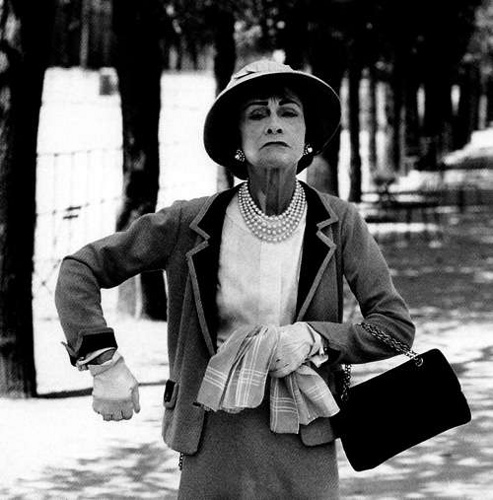
Gabriel 'Coco' Chanel:  Chanel's fame was unaffected during World War II however their famous headquarters at 31 Rue de Cambon closed when Germany invaded France. This left Chanel with the opportunity for a post war revival upon their return to the market. Chanel detested Dior's new look which brought back the necessity for a corset which she had worked so hard to abolish in the 1930s. Chanel was provoked in to action arguing 'There are too many men in this business, they don't know how to make clothes for women. How can a woman wear a dress that's cut so she can't lift up her arm to pick up the telephone?'.She was willing to fight to salvage the new woman she had laboured as her own. This struggle brought about the invention of the Chanel suit, an iconic piece of fashion history. Her winter 1954 collection saw her rework the Chanel tweed in the form of a timeless female suit. The slim skirt and collarless jacket oozed femininity, a gold chain was sewn in to the jacket hem to create a fluid line from the shoulder. The uniform for the emerging working woman was born. 
Chanel Suit 1958

Chanel Suit AW 2014

Saturday, 20 September 2014

1950s Innovators: Dior and Givenchy


Christian Dior: Dior set the scene for the 1950s fashion world. On February 12th 1947 Dior sent out invitations to the showcase of his new collection and let loose a fashion sensation. The 'Corolle' collection (so-called after the delicate petals at a flowers centre) was luxurious, romantic and abundant in fabric. It held no attributes of wartime rationing or improvising and brought femininity back to wardrobes exhausted by the war. Dior wanted to "make elegant woman more beautiful and Beautiful woman more elegant" sighting that "Europe had enough of falling bombs, now it wants to set off fireworks". Dior himself started the celebrations with his new silhouette, sloping shoulders, narrow waists and full hips. His romantic feminine image was achieved with corsets called 'Waspies' and skirts stuffed with petticoats. His collections aimed to surprise and please inventing the A-Line silhouette with its triangle shape and the H-Line silhouette with its slim jacket-skirt combination. Dior's legacy includes the Coolie hat, Trapeze coat and the Hobble skirt. Even in todays fashion world Dior is synonymous with elegance and innovation.

Hubert de Givenchy:  Givenchy possessed a powerful understanding of fabric  and how to work it to his advantage. It was his mantra that, to make a successful dress the fabric must be handled with the utmost care. He débuted his Parisian fashion house with a collection which included the Bettina blouse. Produced from raw cotton shirting, the blouse that was traditionally for couture fittings became a signature look for his career. Givenchy's clientele included Grace Kelly and Jackie Kennedy but his most successful relationship was with film and fashion icon Audrey Hepburn. Originally hoping to meet  the other 'Miss Hepburn'  -Katherine an unexpected relationship was born between Audrey and Givenchy when they met on the set of Sabrina in 1953. Hepburn felt 'It was though I was born to wear his clothes' and a fabulous fashion pairing began. Givenchy designed the timeless black sheath dress that the actress wore in 'Breakfast at Tiffany's' as well as costumes for her role in 'Sabrina', 'Charade' and 'Funny Face'. Audrey Hepburn became his muse, exclusively wearing his designs both privately and professionally. Givenchy embodies the power of a great fashion partnership in the golden age of couture with his simple black sheath dress selling for $807,000 in 2006.

Thursday, 18 September 2014

1950s: Style Features and Fabrics

Christian Dior 1952 - Peplum with pencil skirtThe 'New Look' of the 1950s brought back the classic female form. Cinched in waistlines and full skirts with petticoats shaped the silhouette of the time. Skirts were made from simple fabric like gingham and printed cotton for daytime and for night-time they featured layers of chiffon or rayon in bold colours like baby blue and lime green. Petticoats were stiffened with starch or a sugar solution to create form and movement under the circle skirts. For a more glamorous look petticoats were made using nylon tulle which gave a softer effect for eveningwear. In contrast to the voluminous circle skirt was the hobble or pencil skirt. A slim straight skirt that featured the tiny waistline but no gathers or pleats, just a simple slit in the back to allow for movement.


Shoes By Roger Vivier (The Creator Of The Stiletto Heel) - 1959  L’Officiel De La Mode - 447-448
Roger Vivier Stilettos
Nylon stockings were returned to woman's drawers having been diverted in production to assist the war effort. Their demand sky rocketed and riots were caused when producers held sales. Woman no longer needed to mimic the leg seam using eye-liner and had their trusty companions back again. The female leg was also to reach new heights in the form of the stiletto heel.  Invented by French shoe designer Roger Vivier the stiletto heel complimented the feminine fashion silhouette perfectly. Ladies were offered lessons in how to walk properly in these steel-strengthened pencil-thin heels.

Super cute 1958 outfits. Love Capri and cigarette pants!1950s Greasers in NYC.. I love it!!!!The freedom of the post-war era stimulated the emerging Youth culture. Teenagers no longer felt the need to do as their parents did and set their own agenda bringing style with them. America led the rest of the teenage world with two dominant figures emerging: the Preppies and the Greasers. A Preppy teen's wardrobe featured Capri pants or pedal pushers, scoop neck blouses, tight sweaters or cardigans and three quarter length sleeved blouses with a neckerchief. The greasers sported denim jeans and leather biker jackets a symbol of rebellion that terrified the older generation. Music and film greatly influenced the fashion of teen culture and the fabrics used in clothing production.


In 1954, Dacron a new "Wonder" material came to the market. It was used for many purposes during the 1950s. Dacron is a man made fabric.
In 1952 acrylic was introduced to clothing production world. Alongside Nylon it was marketed as a 'miracle' fabric that was crease-proof, shrink proof and quick drying. Meanwhile  'drip-dry' nylon and Dacron could retain head-set pleats after washing and became a sensation. Along came Polyester in 1953 offering its ability to keep its shape with an anti-wrinkle quality. The domestic female was given an easier washing load with the introduction of synthetic fabric production and the fashion world never looked back.